
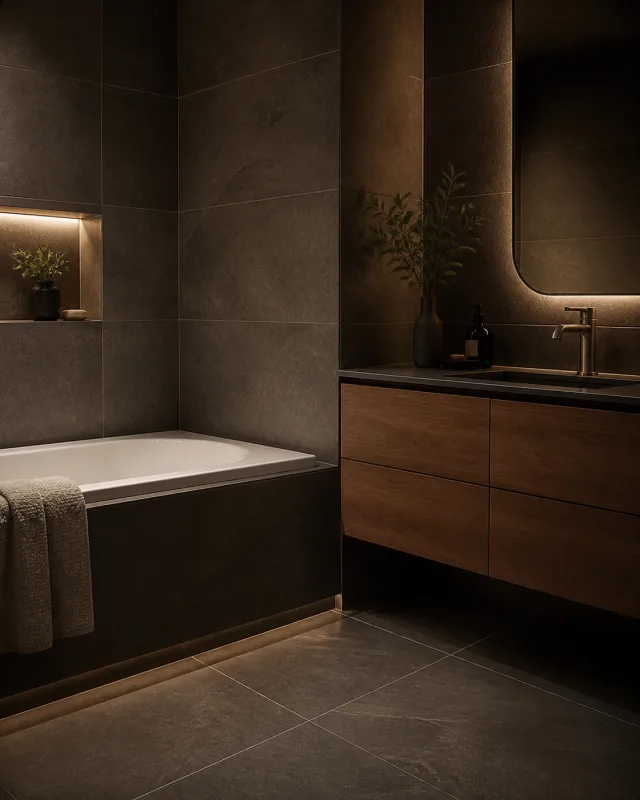
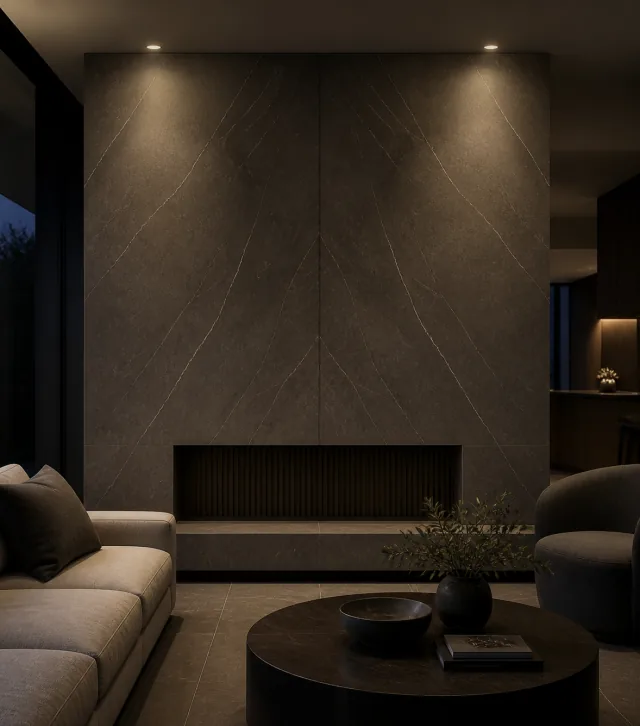
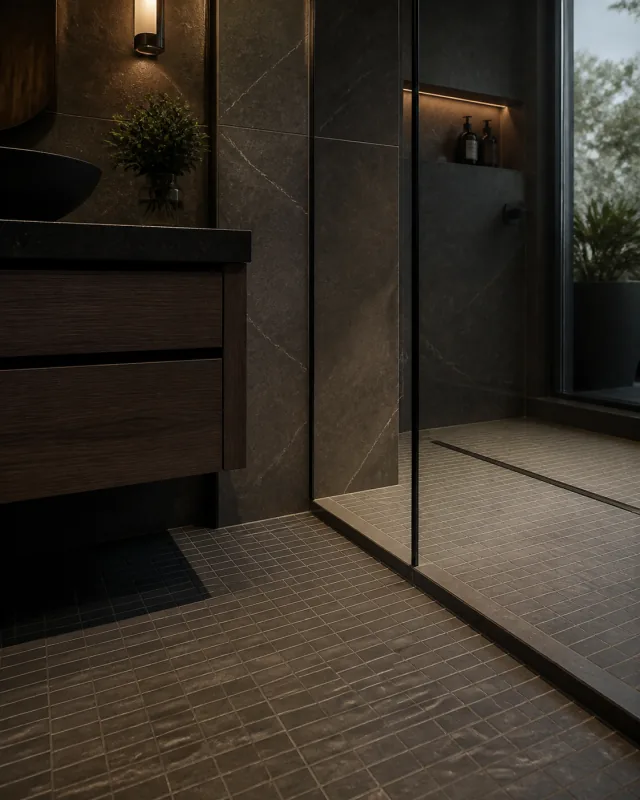
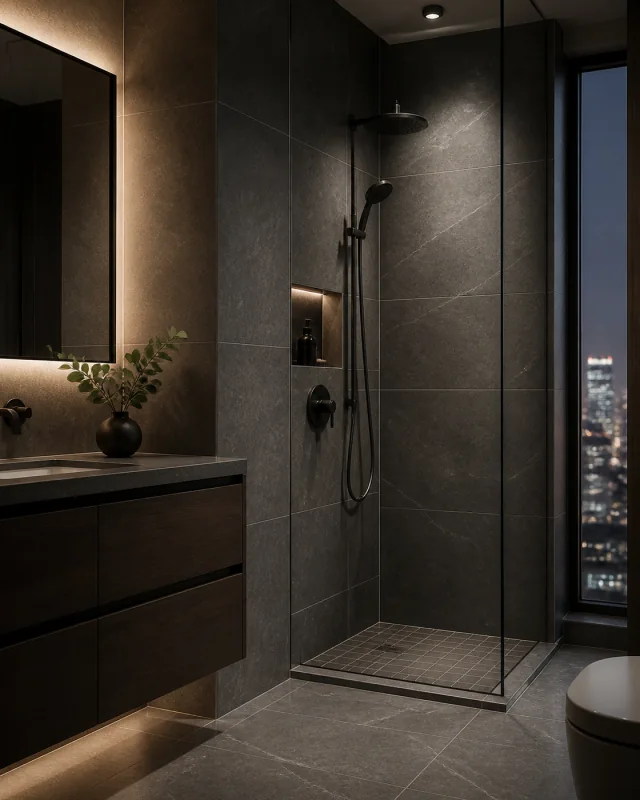

What overage do straight, roomy layouts actually need?
For a straight lay in an open room, published retail guidance puts the extra tile at 5-10%, and Daltile recommends building that margin in from the start: “We highly recommend that you purchase approximately 10% more tile than you anticipate needing for your project. This 'attic stock' will allow you to easily replace any broken tiles or expand your tiled space with tile from the same dye lot and printing process (which can change slightly over years) as the original installation for a perfect match.”
That range is a starting point, not a fixed rule. A square kitchen with one doorway and no pattern asks very little of the tile, while the same footage in a galley with two thresholds and a radiator cut asks considerably more.
If the area figure came from our guide on how to measure floors and walls for a tile installation estimate, that arithmetic is already done.
When do set patterns and diagonals push the figure higher?
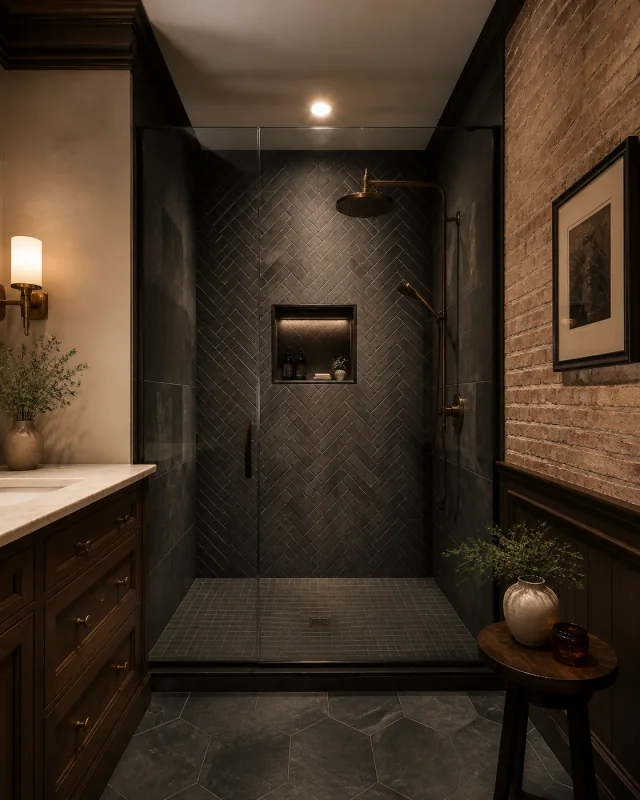
Layout affects consumption, not only appearance. A herringbone, chevron or diagonal field uses more cut pieces at every boundary, and retail guidance puts that requirement at 12-18% extra tile or more, so planning for 15-20% on a heavily cut set pattern is a reasonable working figure.
Pattern charts published by the manufacturer show how many tiles a given area needs, and the pattern you choose changes that piece count for the same floor.
Diagonal and set patterns also make an off-centre room more obvious, so it is worth settling the layout before the order is placed rather than after the boxes are open. Where the pattern runs through doorways or around a fixed vanity, expect the cut count along those lines to rise.
How do cuts, niches and awkward room shapes change the number?
The larger the number of cuts and the more awkward the room perimeter, the more of the order ends up on the cutting bench instead of on the floor. Corners, short wall returns, pipes, floor registers, niches and door casings all consume trimmed pieces that cannot be used elsewhere.
The Tile Council of North America advises that when several boxes are used they should be opened and the tile randomly stacked before installation, which blends the boxes. It also notes that a careful dry layout avoids small slivers of cut tile along walls. That layout happens once the tile is on site, so it is the working margin above that covers a room whose cut count cannot be read off the drawing.
That planning step overlaps with our comprehensive guide to tile floor installation, which covers base preparation, layout and transitions.
Should the order be rounded up to whole boxes?
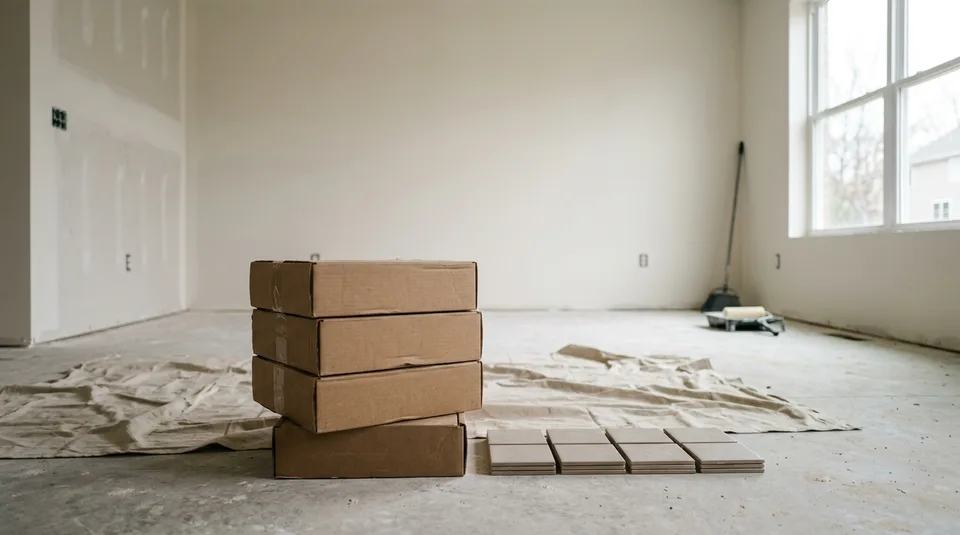
Yes, in most cases. Square footage calculations are always rounded up to the next highest figure, and tile is supplied in full boxes, so the order lands above the raw measured area rather than below it.
Rounding up also covers the tiles that will be trimmed along edges, and it keeps the whole floor inside one batch instead of splitting the project across two purchases.
Ordering to a whole box is not padding. It is the unit the tile actually ships in, and it protects the layout you have already planned for.
How many spare tiles are worth keeping after the installation?
Keeping a small number of unopened tiles is the cheap part of the job. A damaged tile can then be swapped for a matching piece, and a later extension of the tiled area can carry on with the original shade.
Store them dry, in the original packaging, and note the batch details so a later search is quick. Once the tile line changes, that attic stock is the only reliable match left in the house.
If you want to see how the tile figure feeds into an overall number, the tile installation cost calculator gives preliminary installed-cost figures for the room you describe.
What changes when the tile is natural stone?
Daltile, which is explicit on this point, notes that every block and every slab is unique, and that material from a quarry today may be different from what was available six months ago, with more than one quarry supplying the same material. Natural stone is therefore ordered in one go and kept to a single batch, and the attic stock is kept from that same delivery rather than picked up later.
The same guidance applies inside the order. The installer mixes tiles from different boxes so the finished surface reads evenly instead of showing one box against the next, and the spares you keep come from the delivery you actually used.
Common questions
Questions related to this guide.
Is 10% extra tile enough for a herringbone floor?
Usually not. Ten percent suits a straight, open layout. A herringbone, chevron or diagonal field typically needs more, with retail guidance at 12-18% or more, because the pattern multiplies cut pieces along every wall and around every opening. Round that figure up to full boxes.
Can I buy the same tile again if I run short?
Sometimes, but do not count on a match. Shade and printed appearance can change slightly between production runs and over the years, and a later order may arrive with a different caliber. Buying one batch up front is the reliable way to hold a consistent floor.
Should I order one extra box beyond the overage figure?
Square footage is rounded up to the next highest figure and tile ships in full boxes, so the order already lands above the measured area. On top of that, one unopened box kept dry covers a damaged tile years later without needing a matching piece from a new batch.
Does the cost calculator already include the extra tile?
No. The tile installation cost calculator works from the installed area you enter, while the overage applies to the tile you buy. Settle the extra amount on the tile order first, then compare that total with the estimate for the installation work.